How to stop living paycheck to paycheck (even on a decent salary)
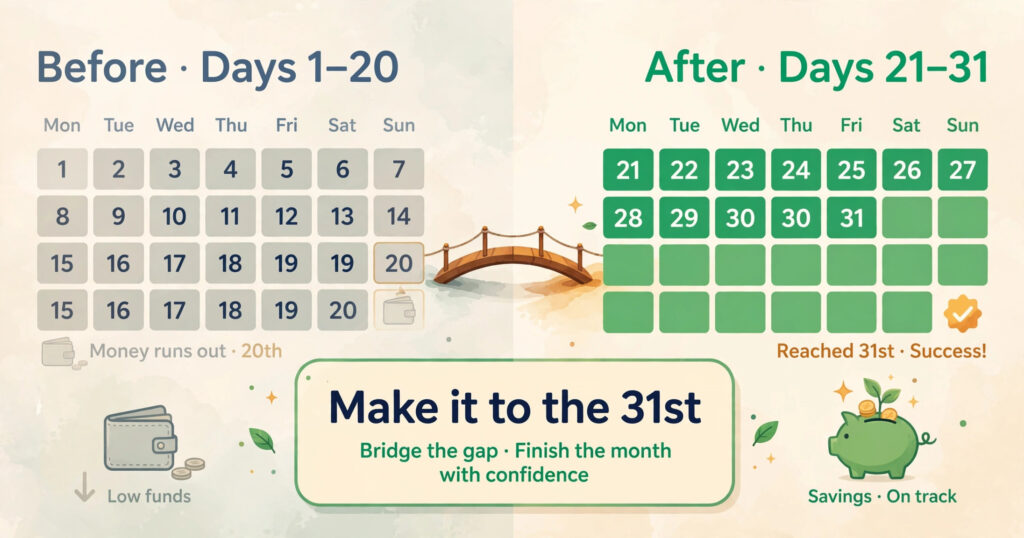
You earn a decent salary, and still the last few days before payday are tight. That does not mean you are bad with money. It usually means two quiet things are happening at once: the timing is working against you, and the spending is drifting a little further than you think. Fix those two things and the cycle breaks — usually faster than people expect.
Why the month runs out before payday
First, the timing. Most budgets are written by the month, but most people are paid by the week or the fortnight. Rent is due on the 1st, the car payment on the 12th, and the paycheck lands on the 15th — so the first two weeks of the month are always a squeeze, even when the monthly maths works out fine. It is not a spending problem. It is a calendar problem. And when the calendar is the problem, the fix is to move the money to match the calendar, not to feel guilty about it.
Second, the drift. Nobody blows a budget in one big purchase. It goes $25 at a time. Lunch out because the meeting ran late. A subscription you meant to cancel. A birthday present, a car wash, a pharmacy run — each one small, none of them in the budget, and together they are $300 or $400 a month. That is the drift, and it is almost always the real reason the account hits zero before payday.
The worked example: where $4,199 actually goes
Here is the worked example, using the same $60,000 salary as the other articles in this series — all estimates, not exact payslip figures. A single filer takes home about $4,199 a month after federal tax and FICA, and about $1,938 per paycheck if paid every two weeks. Now look at a normal month: Planned — Needs $2,100, Wants $1,260, Savings $840, total planned $4,200. That plan works on paper. Now what actually happened: Needs $2,100, Wants drifted up to $1,700, ‘Surprises’ — a car tyre, a gift, a pharmacy run — $300, Savings $0, total spent $4,100.
$99 was left. Then the car needed new wipers and a bulb — $40 — and the account was at $59 with four days to payday. That is the paycheck-to-paycheck cycle. Not a disaster. Just a slow leak, every month, until something bigger comes along and there is nothing to catch it.
Three steps to stop the cycle
So how do you actually stop it? Three things, in this order.
One: pay yourself first, on payday, before the month starts. The moment the paycheck lands, $100 moves into a separate account. Not at the end of the month. At the start. If you wait until the end, the drift eats it. If it moves first, the drift has to work around it. $100 a paycheck is $2,600 a year, and it is the beginning of a buffer. It is also the habit that makes everything else in this series possible — you cannot save $500 a month or build an emergency fund from money that is already gone.
Two: budget on two paychecks, and treat the third as a bonus. This is where the USA pay schedule helps you, if you use it. Biweekly pay — every two weeks — is the most common pay schedule in the USA, used by about 43% of private businesses according to the Bureau of Labor Statistics. That means 26 paychecks a year, and twice a year a month has three paydays instead of two. If you budget as if every month has two paychecks, those two three-paycheck months give you a whole extra paycheck — about $1,938 on our example — to throw at the buffer, the emergency fund, or a debt. Don’t spend it in advance. When it lands, decide where it goes in ten minutes, and move it the same day.
Three: build a $500 buffer before you build anything else. Not an emergency fund yet. Not investments. A $500 cushion in a separate account, whose only job is to catch the tyre, the bulb, the pharmacy run. Once the buffer exists, the surprises stop becoming overdrafts, and the month stops ending in a panic. After the buffer, the next $500 starts the emergency fund — and that is exactly the plan in the emergency fund article in this series.
Split your direct deposit
One USA rule that makes all of this easier: most US employers let you split your direct deposit across two accounts. Ask payroll to send $100 from every paycheck straight into your buffer account, and the rest into your everyday account. You never see the $100, so you never spend it, and you don’t have to remember to move it. If your employer doesn’t offer a split, set the automatic transfer for the morning payday lands. Same effect, one extra step.
What about the first month?
What about the first month? It will not be perfect. The point of the first month is not to be perfect. It is to find out where the drift is. Write down every ‘surprise’ for thirty days — just the amount and what it was, on your phone, in one note. At the end of the month, add them up. Most people find $200 to $400. That number is not a judgement. It is the size of the buffer you need, and now you know it.
When the numbers genuinely don’t add up
And one more thing, because nobody says it: if the numbers genuinely don’t add up — if needs alone are more than your take-home pay — no budgeting trick will fix it. That is not a failure of willpower. That is a maths problem, and the fix is on the income side: a raise, a better-paying role, or extra hours for a season. The raise article in this series is the next place to look. But check the maths first. Most people who think they live paycheck to paycheck because they don’t earn enough discover, once they write it down, that they live paycheck to paycheck because of the drift. The drift is fixable in a month. The income side takes longer. Start with the fixable one.
Do this today: open your bank app and set up an automatic transfer of $100 for your next payday, into a separate account — or ask payroll about splitting your direct deposit. Then write down the three bills that are due before your next payday, and the dates they are due. That is your timing map. Tape it to the fridge.
Frequently asked questions
- I earn a good salary — why am I still living paycheck to paycheck? Usually timing plus drift: bills cluster before payday, and small unplanned spending adds up to $300–$400 a month.
- How much buffer do I need first? $500 is a good first target. It catches most small surprises without touching your emergency fund.
- What if I get paid monthly, not biweekly? Then there are no three-paycheck months — but the same rule works: move the $100 on payday, and budget the month in two halves so the second half isn’t a surprise.
- Should I use a credit card to get through the last few days? Only if you can pay it off in full on payday. If it rolls over, the interest turns a $59 problem into a bigger one next month.
- How long until the cycle actually breaks? For most people, two to three months: one month to see the drift, one month to build the buffer, and then the month where a surprise happens and nothing goes wrong.
General information only, not financial advice. Figures verified 2026-10-28.