The 50/30/20 budget, from your actual take-home pay
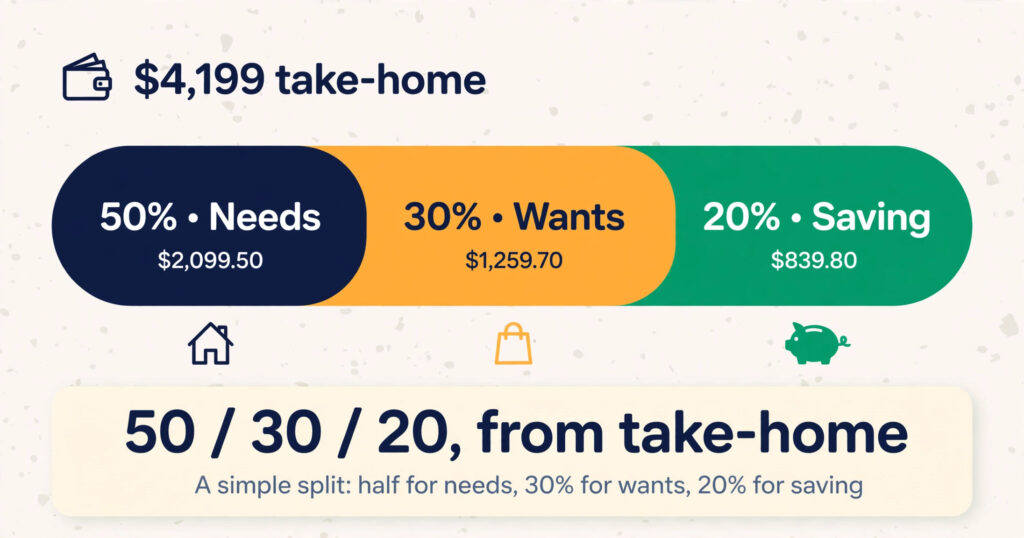
The 50/30/20 rule is simple: 50% of your take-home pay for needs, 30% for wants, 20% for savings and extra debt payments. It only works if you use the right number. Most people plug in their salary and wonder why the budget never fits. Use your take-home pay — the money that actually lands in your account — and the rule suddenly makes sense.
50/30/20 on $4,199 a month
Start with the worked example — an estimate for a single filer with no state tax and no 401(k). A single filer on a $60,000 salary, no state tax, no 401(k), takes home about $4,199 a month in 2026 after federal tax and FICA. Run 50/30/20 on that, not on $5,000: Needs — rent, bills, food, transport, minimum payments — 50% — about $2,100. Wants — eating out, streaming, trips, new clothes — 30% — about $1,260. Savings and extra debt payments — 20% — about $840.
That $840 is the interesting number. It is more than the $500 from the first article in this series, which means a $500-a-month saving habit fits comfortably inside a 50/30/20 budget on this pay — with $340 a month to spare for extra debt payments or a bigger emergency fund. The budget and the saving plan are the same plan, not two different ones.
What if your needs are already over 50%?
Now the honest part: for a lot of people, needs are already over 50%. Rent alone can eat 40% in some cities. If your needs are 60% or 65%, don’t throw the rule away. Shrink the wants bucket first, not the savings bucket. Try 60/20/20 for a few months. A budget you can actually keep beats a perfect budget you abandon in week two. The percentages are a guide, not a test. Nobody is going to check your maths. The only thing that matters is whether there is still money in the savings bucket at the end of the month.
Needs vs wants: the one-month honesty check
The other mistake is putting wants and needs in the wrong buckets. This is where most budgets quietly break. Be honest with yourself for one month: It feels like a need — the newest phone every year — it is actually a want — a phone that works, the upgrade is the want. Ordering in five nights a week — food is the need, the delivery is the want. The premium streaming bundle — one service at a time is enough. A car payment on a new car — transport is the need, the new car is the want. Coffee every morning on the way in — coffee is the need, the $6 café cup is the want.
Run that check for one month and the numbers usually fix themselves. Most people find $100 to $200 of wants hiding in the needs column. That is not a failure. That is the budget working — it showed you something you couldn’t see before.
Where does a 401(k) fit in 50/30/20?
One USA detail that changes the maths: a 401(k) contribution comes out before tax, so it lowers your taxable income and your take-home pay at the same time. That is fine — count the 401(k) money in your 20% savings bucket, even though it never reaches your bank account. If you put 5% of a $60,000 salary into a 401(k), that is $250 a month of saving, and it counts. Your budget just runs on the take-home pay that is left after it. And if your employer matches part of it, that match is saving too — it just doesn’t come out of your pocket.
How to try it for one month
How do you actually try it for a month? Don’t build a spreadsheet with forty categories. Do this instead. On payday, move the 20% — about $840 in our example — into a separate account, before anything else. Then live on what is left. Check the balance once a week, not once a day. At the end of the month, look at what ran out first. If the wants money ran out on the 25th, that tells you something. If the needs money ran out on the 15th, that tells you something else, and it is usually about rent or the car, not about coffee. Fix the biggest one first.
And if the month goes badly, don’t quit. One bad month is data, not a verdict. Adjust the split, keep the habit of moving the savings first, and try again. The people who make budgets work are not the people who get it right in month one. They are the people who are still trying in month four.
Do this today: check your take-home pay, multiply it by 0.5, 0.3 and 0.2, and write the three numbers on a piece of paper. Then check last month’s bank statement against them. One number will surprise you. Fix that one first.
Frequently asked questions
- Is 50/30/20 a rule or a guideline? A guideline. The split matters less than having a split at all, and keeping savings above zero every month.
- What if my rent alone is 50%? Then use 60/20/20 or 65/15/20 for now, and work on the biggest cost — usually housing or the car — instead of cutting coffee.
- Where does a 401(k) go in the budget? In the 20% savings bucket, even though it comes out before tax.
- Does the rule use gross or take-home pay? Take-home pay. Always. Gross pay includes money you never see.
- How often should I redo it? Every time your pay changes, and once a year anyway. A budget from two years ago is a guess, not a plan.
General information only, not financial advice. Figures verified 2026-10-28.