How to save $500 a month on a $60,000 salary
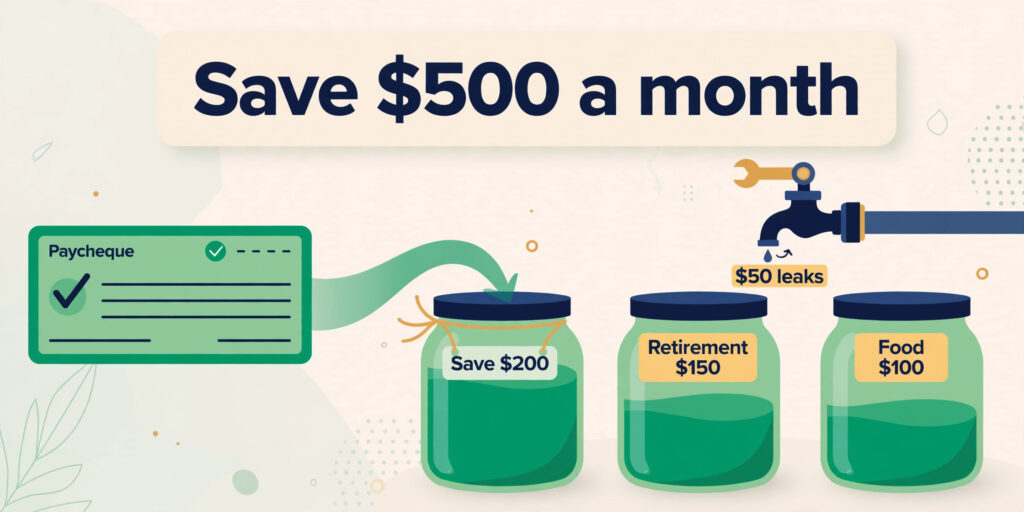
Can you save $500 a month on a $60,000 salary? Yes — but only if you start from your take-home pay, not your salary. $60,000 sounds like $5,000 a month. It isn’t. After federal tax and FICA, a single filer with no state tax takes home about $4,199 a month. That is the number your budget has to work with, and $500 is about 12% of it. Hard, but not fantasy.
Start from your take-home pay, not your salary
I made the same mistake everyone makes. I budgeted from the gross number, felt rich on paper, and wondered where the money went by the 20th. The fix was boring and it worked. I stopped guessing and wrote down what actually left my account last month. Rent, food, car, phone, the subscriptions I had forgotten about. The total was higher than I thought. It usually is. That is the whole point of looking.
Where does the $500 a month come from?
Here is the worked example. Treat it as an estimate — state tax, health-insurance premiums and 401(k) contributions will move the number. Take-home pay is $4,199 a month. The $500 target breaks down like this: Emergency fund, moved on payday before anything else — $200. 401(k) or IRA top-up — or the same savings account if you have no retirement plan yet — $150. Food — cooking four nights a week instead of ordering in — $100. Subscriptions and small leaks — the streaming service nobody watches, the app that renewed itself — $50. Total $500.
None of that needs a second job. None of it needs you to stop living. It needs one automatic transfer and a few honest decisions about food and subscriptions.
Where does the money usually hide?
Where does the money usually hide? In my experience, it is almost always the same five places. Food delivery, three or four times a week, at $25 a time. A subscription stack that quietly adds up to $60 or $80 a month. The “small” daily coffee that is actually $120 a month. A car payment that made sense when you signed it and doesn’t now. And the random $20–$40 purchases — the thing on sale, the thing for the house — that never make it into any budget because nobody writes them down. You don’t have to cut all five. Cut two, and the $500 is mostly there.
Pay yourself first: the payday rule
The part most people skip is the payday rule. If the $200 moves on payday, you never miss it, because you never see it. If you wait until the end of the month and save “whatever is left”, the answer is usually nothing. Set the automatic transfer for the morning your pay lands. Do it once, in ten minutes, and the rest of the month takes care of itself. This is the single most important sentence in this article.
The 401(k) match comes first
One USA rule worth knowing: if your employer offers a 401(k) match, take the full match before you save anywhere else. A typical match is 50 cents or a dollar for every dollar you put in, up to a few percent of your pay. That is an instant return no savings account can beat. For 2026 you can put up to $24,500 of your own pay into a 401(k). You don’t need to get near that number for this plan to work — even 3% of a $60,000 salary is $1,800 a year, and with a match it is more. The match is free money, and leaving it on the table is the most expensive habit in this whole article.
What the first month actually looks like
What does the first month actually look like? Week one, set the $200 automatic transfer and cancel one subscription you haven’t used in a month. Week two, cook four nights and notice how much is left in the food budget. Week three, check the savings account — the $200 is already there, and you didn’t miss it. Week four, move whatever is left over, even if it is $30, into the same account. By the end of month one you will know whether $500 is realistic for you, and you will have proof instead of a guess.
What if $500 feels impossible this month? Start with $200. The habit matters more than the amount in month one. Raise it by $50 every time your pay goes up, or every two months, until you hit $500. People who try to go from $0 to $500 overnight usually quit by week three. People who build up to it tend to still be saving a year later. Slow is not failure. Slow is how it sticks.
Do this today: open your bank app, look at last month’s spending, and set up one automatic transfer of $200 for your next payday. Just that one. The other $300 can wait until you have seen where the money actually goes.
Frequently asked questions
- Is $500 a month a lot on $60,000? It is about 12% of take-home pay. It is ambitious, but it fits inside the usual 20% savings guideline.
- Should I pay off debt first? If the debt charges high interest, like a credit card, pay that down first — the interest usually costs more than savings earns.
- Do I need a 401(k) to do this? No. A savings account works for the emergency fund. The 401(k) only matters if you want the tax break and the employer match.
- What counts as an emergency fund? Money you can reach in a day, in a separate savings account, for things like a car repair or a month without work — not a holiday fund.
- What if my state has income tax? Then your take-home pay is lower than $4,199. Check your take-home pay on the calculator and redo the $500 split from that number, not from $60,000.
General information only, not financial advice. Figures verified 2026-10-28.